
Oscar Wilde’s radical notion of the Confraternity of the Faithless – posited during his incarceration in Reading Gaol during 1897 – had a practical precedent in the Cult of Reason, which had formed in the maelstrom of the French Revolution a little over one hundred years previously.
The avowedly atheistic founders of the Cult – including Antoine-François Momoro, who had famously coined the Revolutionary motto ′′Unité, Indivisibilité de la République; Liberté, égalité, fraternité ou la mort′′ – sought to replace French Catholicism with a civic, secular and Humanistic religion venerating philosophical principles such as Reason, Beauty, Nature and Truth.
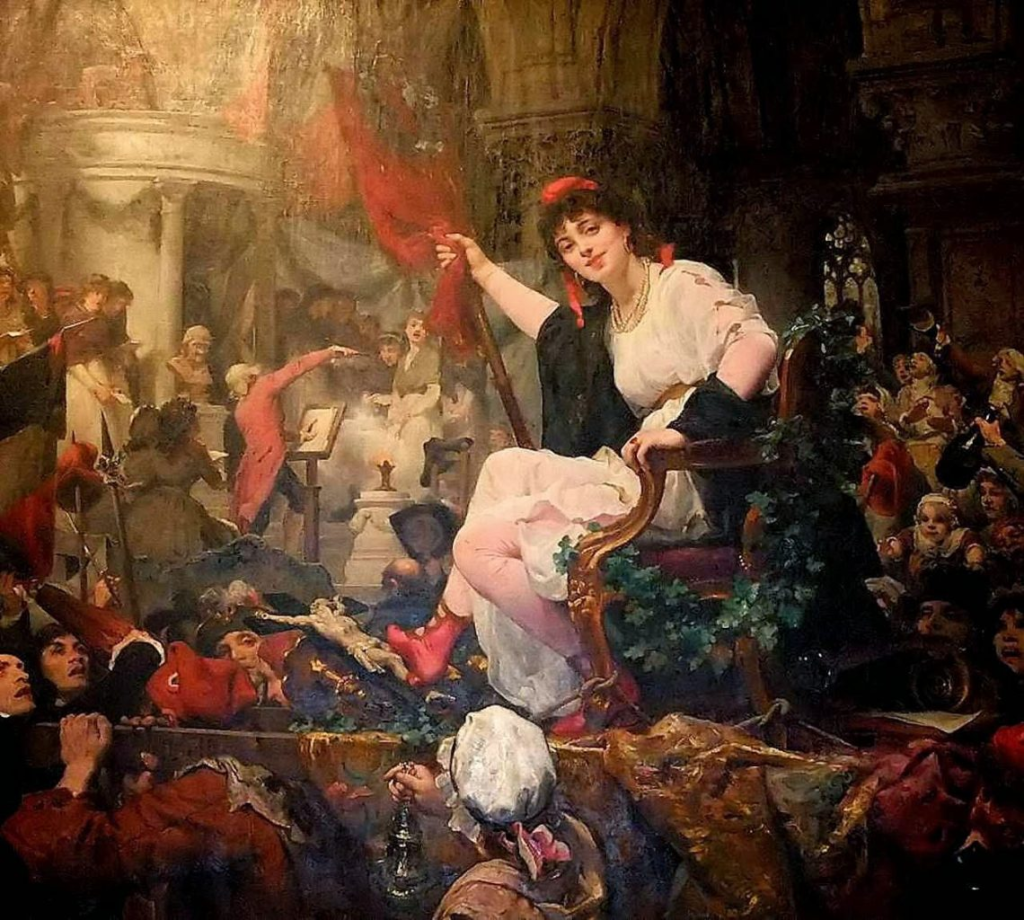
During the Cult’s roughly year-long heyday, many formerly Catholic churches were renamed and repurposed as “Temples of Reason,” including Notre Dame Cathedral in Paris, which hosted a grand “Festival of Reason” on the 10th of November, 1793. Inspired by the aesthetics of ancient Roman
religion, the Festival featured performers costumed as “Goddesses (or, more accurately, personifications) of Reason,” and much mythopoetic merriment was made.
The Cult of Reason was, however, quickly quashed by Maximilien Robespierre during his dictatorial Reign of Terror. Robespierre then instituted his own, deistic religion for the new Republic, the Cult of the Supreme Being, with himself as the symbolic figurehead.
Robespierre’s Cult was even more short-lived, as it was widely perceived as a megalomaniacal power-grab; around six weeks later, he was arrested and then executed.