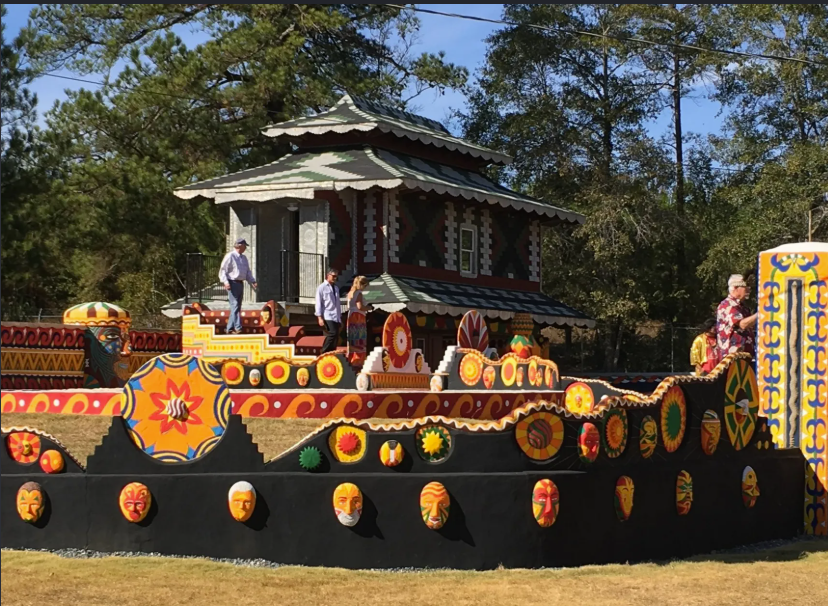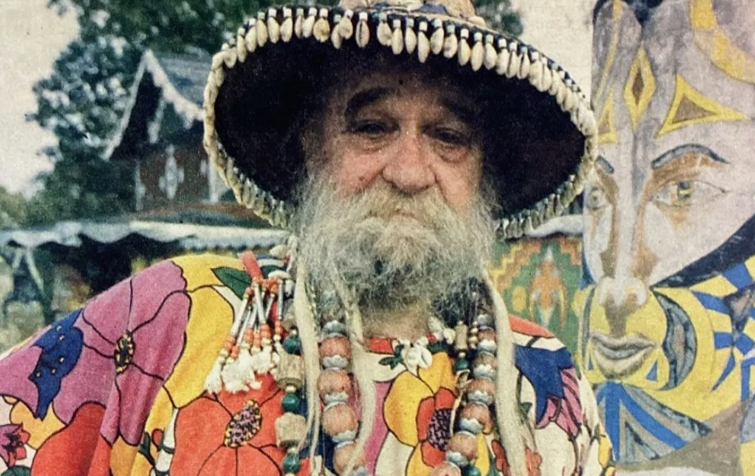
Pasaquoyanism was the religion of Eddie Owens Martin, the visionary artist better known as St. EOM. Its chief monument is Pasaquan, the seven-acre sacred environment he constructed near Buena Vista, Georgia from the mid-1950s until his death in 1986. There, brightly painted walls, temples, pagodas and monumental figures announce the presence of an imaginary civilization seemingly compounded from pre-Columbian America, Africa, Asia and the psychedelic future.
Martin traced Pasaquoyanism to visionary experiences. During a severe fever, he encountered three enormous humanoid beings who identified themselves as Pasaquoyans: members of an enlightened people existing in the distant future. They subsequently instructed him to return to his family property in Georgia, build a sacred compound and prepare the way for their culture. Martin became St. EOM – his initials transformed into a saintly name – and declared himself the first Pasaquoyan of the present age.
It is difficult to identify a consistent Pasaquoyan theology. Martin left no systematic scripture or creed and his explanations varied over time. The fragmentary ideology that can be recovered emphasized harmony with nature, the convergence of different cultures and races, bodily vitality and contact with beneficent cosmic forces. Hair held particular power. St. EOM grew his hair and beard extraordinarily long, arranged them into elaborate constructions and incorporated similarly magnificent hairstyles into his representations of the Pasaquoyans. Hair seems to have functioned as an antenna, conductor or visible accumulation of spiritual energy.
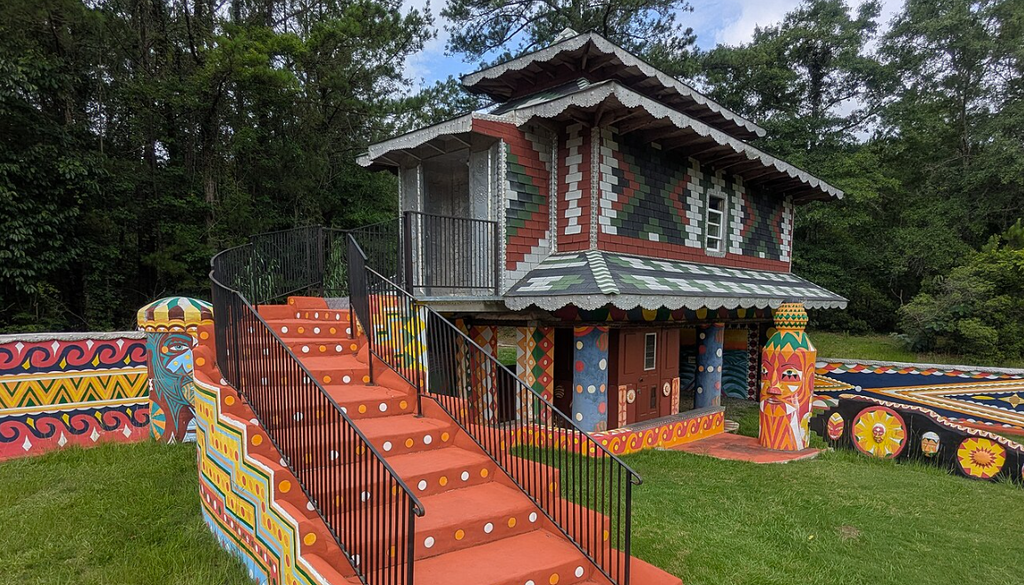
To judge Pasaquoyanism chiefly by the coherence of its doctrines, however, may be to mistake the medium in which Martin worked. This was not primarily a religion of propositions. It was a religion enacted through artistic labour, architecture, costume and the transformation of the self. Martin did not simply describe Pasaquoyanism. He changed his name and appearance, assumed its sacred office then spent nearly thirty years building its holy ground. Pasaquan was simultaneously temple, monastery, future ruin, ceremonial precinct and embassy for a civilization that had not yet arrived.
Its artistic vocabulary performed much of the work that scripture performs in more textual religions. Recurring eyes, faces, serpentine forms, radiant colours and vast stylized bodies established a world in which human beings, vegetation, architecture and cosmic energy belonged to a single visual order. Martin’s borrowings from Indigenous American, African and Asian art were freely imaginative rather than historically disciplined. Pasaquan did not represent any actual culture. It proposed a synthetic future culture in which the forms of many civilizations had converged.
This futuristic orientation distinguishes it from religions that seek authority in antiquity. The Pasaquoyans were not forgotten ancestors awaiting revival but future beings reaching backwards through time. St. EOM’s task was to create their first foothold in the present. Pasaquan therefore operated as a form of anticipatory archaeology: the remains of a religion built before the civilization that might have produced them.
Martin apparently hoped to spread the Pasaquoyan message, but no congregation formed around him. In practice, founder, prophet, priest, artist and principal adherent remained one person. Yet Pasaquoyanism was more than an eccentric belief system enclosed within his imagination. Its material embodiment gave it public presence and durability. Visitors could enter its sacred geography, confront its superhuman inhabitants and briefly occupy the future Martin had revealed.
Pasaquoyanism is best understood as an art religion whose central doctrine was Pasaquan itself. Its theology may be inconsistent because its truth was not meant to reside primarily in statements. It resided in the sustained act of bringing an impossible culture into material existence – and in St. EOM’s transformation of his land, his body and his life into evidence that the Pasaquoyans were already here.