
Gregory Maguire’s Wicked series of novels deepens L. Frank Baum’s classic Oz mythos by expanding their psychological, cultural, political and religious themes.
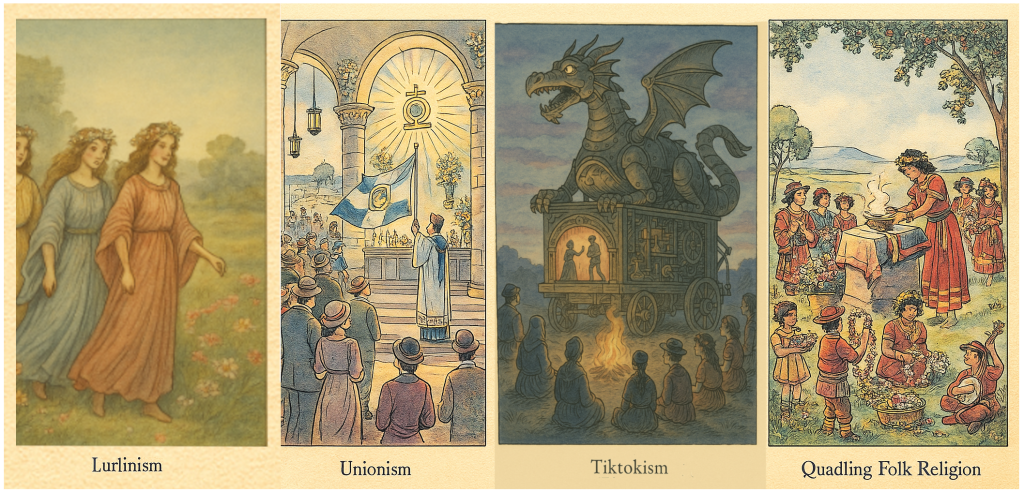
In Baum’s stories, the only religious impulse even alluded to is a faith in Lurline the Fairy Queen, who was in a sense the creatrix of Oz in that she was responsible for its enchanted state; prior to her magicks, it had been an “ordinary place”. In Maguire’s take, she has become the center of a loosely-organized Pagan religion known as Lurlinism, which – by the time of the Wizard of Oz, Glinda the Good and Elphaba, the so-called “Wicked Witch of the West” – is becoming unfashionable; an ancient and sentimental nature faith, adhered to mostly by children, old people and country-folk. The winter festival of Lurlinemas is still, however, quite widely practiced.
The main cause of the decline of Lurlinism is the rise of Unionism, the monotheistic, institutional worship of the “Unnamed God” which serves as an analog of the Abrahamic religions. Maguire describes it as:
(…) that more established faith found more in cities. It has a kind of allegiance with Christianity in that it has churches, basilicas and bishops, but there is no savior. The God is unnamed, influential and mysterious. In this way, it takes some tropes from faith traditions that favor a more amorphous spirit head. That is both a kind of Protestant attitude — the crashing of statues and smashing of windows, etc. — but it also has a bit in common with Islam, which disallows the depiction of Allah, except through the writing of Allah’s name. So Unionism is an odd amalgam of that instinct in certain religions to try to keep the image of God open and therefore more accessible. Interestingly enough, of course, it is also less accessible if you can’t hang an image on it.
The newest Ozian cult in Maguire’s stories is Tiktokism, named after the Ozian slang term for mechanical machinery. It seems to have arisen in connection with the Time Dragon Clock, a traveling marionette show featuring a huge clockwork dragon, associated with prophecy:
A Tiktokist is the kind of person who won’t go into a church and turn off their phone. Their allegiance is to the stimulation, to the connection and to the appliance. While we don’t have cellphones in my Oz, there is a kind of reverence for that aspect of that moment in the Industrial Revolution which Oz seems to be going through. Tiktokism is a more dangerous shifting of the devotional impulse away from the question of creation and toward the questions of utility.
Finally there is the class of folk-religions among the Quadlings, Vinkus and other Ozian cultures which are known to outsiders as the Pleasure Faiths, an umbrella term for a form of magical hedonism:
Pleasure Faithism is, in my mind, a kind of Carnival picture of God. It puts a higher premium on spectacle. It involves the Greek idea of theater, coming together for a kind of epiphany and catharsis.
Tiktokism is associated with the Pleasure Faiths, though the precise nature of the connection is unknown.
Notably, Elphaba herself is an atheist, having abandoned her childhood religion in favor of her political cause of protecting the Talking Animals.